Liminal People: Screenings & Guided Meditation
Eastside Projects, Birmingham
Friday, 3 March 2023
5 – 8pm
Free. This event is part of Digbeth First Friday
Join us on Friday 3 March for a guided meditation led by holistic artist Tesha Murrain (5 –6pm), followed by a screening of moving image works (6–8pm) by artists including Amartey Golding, De’Anne Crooks , Larry Achiampong & David Blandy, and Tanazia Gabriel-Fleary.
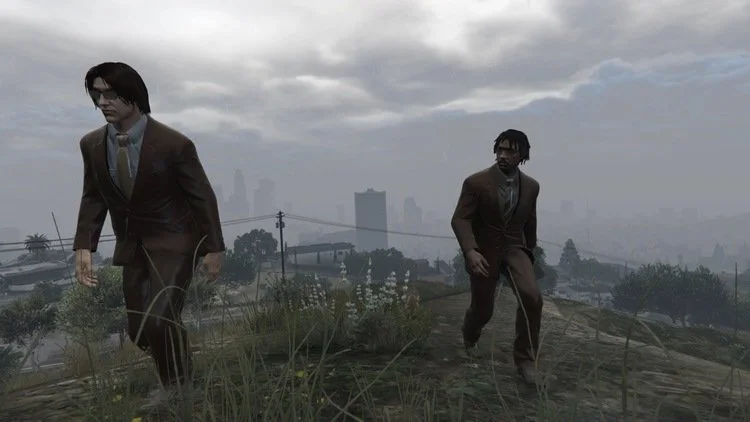
Still, Finding Fanon 2, Larry Achiampong & David Blandy, 2015
The evening will explore how displacement and marginalisation can create roadblocks on the journey to self-actualisation. The films draw upon the musings and anxieties present within the Black British Diaspora – refuge from systemic violence; the tangibility of ‘Black Britishness’; a lack of tools to work through trauma; and the other cultural-social implications of a postcolonial aftermath.
Ongoing displacement, Western ideals of the individual, and “survival/grind culture” have left many Black Brits unequipped to engage with their heritages, work through personal baggage, or tackle their present journey to self-actualisation.
This isn’t specific to Black Brits, nor is it new. The feeling of being other is palpable in displacement and is often experienced by those on the margins of society. This tangible and figurative space is liminal: a heterotopia for people to be systemically discarded and forgotten.
By refusing space and resources to ‘deviants’, the poor, or ‘inefficient labourers’, community ties can be interrupted, and individuals can become further isolated.
The displaced Black Diaspora has a global presence, precisely because we are not home, nor can we return to it. The entire planet is our liminal space, temporarily inhabiting us, a liminal people, on a collective and personal journey to self-actualisation.
Personhood is often seen as an individual thing, but what if it was a relational process? What if the journey to self-actualisation required connections to the past, to each other, and to the future?
––
GUIDED MEDITATION, Friday 3 March, 5 – 6pm
Tesha Murrain-Ernandez is a Jamaican-Montserratian wellness artist, interested in themes of community space, herbology, Afro-Spiritualities & Cosmologies, and somatic movement. With a background in teaching, autism assessment, and managing challenging behaviours in learning spaces, as well as having a migraine disability herself, Tesha is interested in finding ways to make art more accessible to herself and the wider community.
––
FILMS, Friday 3 March, 6 – 8pm
Amartey Golding, Chainmail 3, 18’22”, 2018
Set in the protective comfort of Amartey’s living room, Chainmail 3 meditates on Amartey’s relationship with his brother – an Officer in the British army – and the non-violent and anti-empire philosophies of their Rastafarian upbringing. Drawing on Amartey’s need to protect his younger brother whilst on his first tour in Afghanistan and the anxiety of not being able to do so, the suit is by far the largest created to date. Weighing 166kg and stuffed with horsehair, it took Amartey and 4 studio staff 5 months to complete. The suit takes inspiration from Samurai armour acknowledging their attitudes to war and death, and references the 90’s puffer jackets the brothers used to wear as children. The film, which uses an anonymous protagonist, reflects on human nature and the point at which the fear of death begins to affect the quality of life and questions how, if at all, this dynamic may be overcome.
––
De’Anne Crooks, Great(ish): Gaslighting of a Nation, 10′, 2020
Great Britain has long had an extravagantly high opinion of itself – look no further than its choice of name, with all the swagger and hauteur it implies. Great ambitions fuel great expectations, but as its aura of grandeur starts to fade, it’s not uncommon for a nation to big itself up again at the expense of others, whether they be outside or inside its borders, De’Anne Crooks’ Great-ish: The Gaslighting of a Nation is a stark, impassioned inventory of just how far Britannia falls short in its numerous claims and pretensions, particularly towards its marginalised, minority communities. Held together by a poetic monologue that draws inspiration from Toni Morrison, Hilton Als and Danez Smith, and performed against a backdrop of domestic scenes (all familiar from the time of lockdown, but with a low-tech feel that evokes a nostalgia for an earlier, happier time), Crooks’ 10-minute video gains even greater poignancy by taking the form of a love letter to the artist’s unborn child, warning them about the struggles that lie ahead, preparing them for the dilemmas they are certain to face. Prominent among these, as the video’s subtitle, the gaslighting of a nation, suggests, is the insidious pressure that will be brought to bear to convince Black Britons that the racism and discrimination they regularly encounter is more a facet of their mind rather than the habitual expression of the structures of white supremacy underlying the apparently liberal and munificent state. Comparing these patterns of brainwashing and coercion to the various stages of a toxic relationship with a manipulative spouse, Crooks calls out a uniquely British flair for duplicity, disinformation and distortion. Combining a heartfelt tenderness with a hard-won knowledge that only comes from bitter experience, Great-ish is a vivid reminder, if any reminders were ever needed, of how a hopeful future cannot come into being until Britain confronts the legacies of its past.
––
Larry Achiampong & David Blandy, Finding Fanon 2, 9′, 2015
‘Finding Fanon 2’ collides art-house cinema with digital culture’s Machinima, resulting in a work that explores the post-colonial condition from inside a simulated environment – the Grand Theft Auto 5 in-game video editor. This video work combines several stories, including how the artists’ familial histories relate to colonial history, an examination of how their relationship is formed through the virtual space, and thoughts on the implications of the post-human condition.The Finding Fanon series is inspired by the lost plays of Frantz Fanon, (1925-1961) a politically radical humanist whose practice dealt with the psychopathology of colonisation and the social and cultural consequences of decolonisation. Throughout the series, Achiampong and Blandy negotiate Fanon’s ideas, examining the politics of race, racism and decolonisation, and how these societal issues affect our relationship amidst an age of new technology, popular culture and globalisation.
––
Tanazia Gabriel-Fleary, Mind of Colour, 10’17, 2020
An introductory exploration into the mental health of Black men based in the West Midlands.
––
This event is curated by Jaz Morrison.
Come for the whole evening, or drop in when you can as part of Digbeth First Friday.
Eastside Projects